Saturday, January 26, 2013

Pulp Fiction

Tarantino's Pulp Fiction remained on my nemesis list for years. If I were to pick a most embarrassing nemesis film, Pulp Fiction would probably be it. It constantly comes up in conversation and it holds a special place in my generation's minds where if you haven't seen it, you are lost. I finally watched it with my brother, Dave, over the break. He had been a constant taunter of my not having seen it, telling me, "How can you even say you like movies?" So I got fed up. I got money for Christmas, went to a movie store at the mall, and bought it.


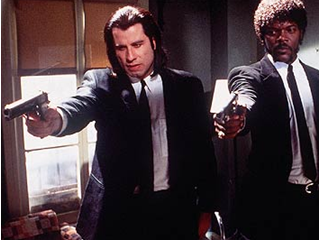
For those who share this embarrassing omission with me and, consequently, aren't familiar with the plot, I'll do my best to try to give a rundown. Pulp Fiction is Quentin Tarantino's Oscar nominated masterpiece from the mid 90s. It weaves several plots together into a beautiful, fast-paced, non-linear, film. Our stars are John Travolta (when he was still making good films) as Vincent Vega, and Samuel L. Jackson as Jules Winnfield: two hitmen who work for Marcellus Wallace (Ving Rhames.) Vincent is tasked with taking Wallace's wife, Mia (Uma Thurman) out for a night on the town. And that's just one subplot. There's a mysterious opener for the movie involving a diner robbery by two lovers (Tim Roth and Amanda Plummer) of which we have to wait two hours to see the outcome. There is also a great subplot involving a boxer named Butch (Bruce Willis.) The subplots are connected through Marcellus and play out back and forth like a tennis match throughout the film.

Movies longer than two hours can be very hit or miss for me. Wonderfully applauded films such as There Will Be Blood or The Lord of the Rings films can lose some of their value when it requires the viewer to set aside a whole afternoon to watch. Pulp Fiction clocks in at 154 minutes, which is hefty. That's not to say that movies cannot be constantly entertaining for more than two hours. When I watched Gangs of New York for the first time, I was itching for more after 166 minutes. But it's a tall order to fill, and Pulp Fiction had me for the full run time. It's constantly got your attention. Tarantino is a master of dialogue, as usual. His films tend to weigh in on the long side, but they're never boring. Of course, the action is all well and good, but even his dialogue is a thrill to sit through.

The prize of the film is its actors in roles of all sizes. Travolta is wonderful and lays down a multifaceted character. He's a hitman you can love. Samuel L. Jackson as Jules Winnfield, on the other hand, is a hitman you must love. Jackson commands every single scene that he's a part of, from his zealous bible quoting to his wonderful sense of humor. The role makes it clear why Samuel is a huge star even today. He's a Tarantino frequent flyer and he's wonderful every time. My brother and I have always agreed that every Kubrick shot is a photograph worthy of framing. In the same way, every Tarantino line is a quote worthy of remembrance, especially Jules'. Jackson's character is incredible and never a bore to watch while Travolta's covers a more subdued range. They're the perfect duo. The film is some of Uma Thurman's best work. Her scenes with Travolta are natural and filled with sexual tension. Horror movies have tremendous suspense, but it's possible to have suspense without anyone getting gored and Thurman and Travolta nail that idea in every one of their scenes.


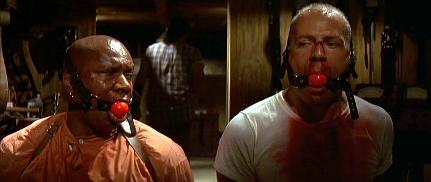
Bruce Willis is known more today for his hollow action films, but there was a time where his roles were deep and troubled. He's certainly a wonderful actor, but he's stopped showing it often. In the 80s and 90s, he took roles that meant something and Butch in this film is no exception. You feel for the guy. He's a bit of a brute, but he's someone you can sympathize with. He puts his life in danger to retrieve a family heirloom. No matter how much he yells in the movie, Willis' performance always has that subtext that he's only lashing out because he wants to hold onto his father. Willis is the unlikely heart of the film. His mercy towards Marcellus is made potent yet believable by Willis. Ving Rhames is a wonderfully intimidating man, perfect for the sort of man that Marcellus Wallace is. The scene after Marcellus' rescue between Willis and Rhames is perfect. The actors take their time, and you can feel the shame and violation from Rhames resulting from the heinous act performed on him. As with most of the characters in this movie, Marcellus is brutal, but you feel for him and accept his brutality.
One of the prominent treasures of Tarantino movies are his bit parts. He writes these incredibly wonderful characters and only puts them in a scene or two and rips them away from us right when we've realized why we love them. He also goes the extra mile in hiring some of the best actors imaginable to play these people. It's a common Tarantino tactic, but it is extra apparent in Pulp Fiction. There's Tim Roth and Amanda Plummer as Pumpkin and Honey Bunny. They appear in only one location, but their intensely good screen chemistry makes them memorable. Tim Roth's scene with Samuel L. Jackson is one of the better parts of the movie for me. There is also the legendary Harvey Keitel as Winston Wolf, a to-the-point "cleaner" reminiscent of Breaking Bad's Mike Ehrmantraut, except with style. One of the most talked about and quoted scenes of the entire movie features a character who only has a few minutes of screen time. It's an incredibly small part and, in reality, Tarantino could have hired just about anyone, but he went with a screen legend: Academy Award winner Christopher Walken as Captain Koons. It's the funniest damn scene in the whole movie. As in many of his films, Tarantino also plays a role as Jules' friend Jimmie.


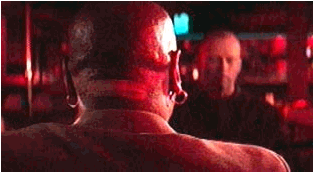
Like all Tarantino films, the movie has style in all aspects. Its shots are beautiful and iconic. Any of the above photos would make welcome additions to my wall space as posters. An especially effective shot is how the whole scene between Marcellus and Butch early on in the film is seen only as a shot of Bruce Willis and the back of Ving Rhames' head. It instantly creates a sense of mystery and danger surround Marcellus, which is important to the rest of the film because the stakes of every character relies on Marcellus being effectively terrifying to cross. Vincent nearly letting Mia die under his watch or Butch trying desperately to avoid Marcellus or Marcellus himself when he is freed from his bondage and put in a room alone with his rapists would not be the same if we weren't scared to death of Marcellus from the very start. Tarantino accomplishes that effect with a single shot in a single scene. 
Tarantino's use of music first struck me when I watched the two Kill Bill movies for the first time. Tarantino has no problem letting wonderful music take center stage in his films. It is a marriage of film and music when you see a Tarantino film. Quentin knows how to pick his music. He never makes the music subtle or pushed to the background. Quentin wants us to know that the music is important. It's almost a character in the film. A particularly memorable music scene in this specific film is the use of Chuck Berry's "You Never Can Tell" in the restaurant with Mia and Vincent. 


So is this film worth all the insane hype that it gets? Of course. I saw nearly every other Tarantino film before this one and this is a clear front runner. It is endlessly entertaining, beautifully structured, and fantastically written. Tarantino doesn't seem to be capable of a bad film. His movies are filled with style, humor, and entertainment. If not for the experience of the story itself, go see the film for the sake of being able to respond to your friends' exclamations of "What does Marcellus Wallace look like?" with a proud and loud "Does he look like a bitch?" 

Rating: 5/5
See it for: The Quotes, The Music, Samuel L. Jackson
Quote of the Movie: "Does he look like a bitch?" -- Jules Winnfield (And pretty much anything else that comes out of Jules' mouth)


Wednesday, January 23, 2013

Midnight Cowboy

The first nemesis film falls, run down by a taxi in the middle of New York City despite the fact that it was "walkin' here!" Midnight Cowboy has been on my radar for years now. I never quite knew what it was about or why I wanted to see it. Was it the X-Rating? Sure, that had something to do with it. I've seen some crazy things in movies, but those films were never given the elusive X-Rating. So, in a way, I had to know what was so provocative about this film. But, promise of a bare chest or some gore isn't going to be enough to make me see a film. So maybe it was the famous quote: "I'm walkin' here!" After all, my interest in Taxi Driver came from the iconic "You talkin' to me?" and I certainly wanted to know what was relevant about the greatest trick the devil ever pulled in The Usual Suspects. But a quote isn't enough to draw me in either. It takes more than that. If I were to credit anyone, it would be the great Dustin Hoffman. He doesn't get nearly as much credit as his generational acting brothers, Deniro and Pacino, but Hoffman always promises a wonderful performance.

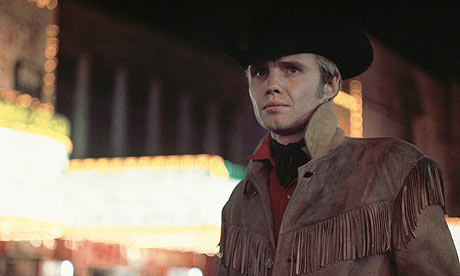
For those as ignorant as I was before I saw this film, the plot follows Joe Buck (Jon Voight) as he abandons his mundane Texan life to become a "hustler" in New York City. There are lots of rich women willing to pay a Lone Star stud for "attention" and Buck is looking to cash in. He meets along the way Rico Rizzo (Dustin Hoffman) a slightly crippled swindler who ends up bonding with Buck. The film follows, with no apologies, the cowboy's fall from naivete into the seedy underworld of New York City. It's a film bathed in disappointment, reality, and failure, all the while flirting with the theme of companionship as Buck and Rizzo become more dependent on each other.

I never expected a movie about an aspiring male prostitute to be so tender and emotional. Buck is a jerk, but I think we can all relate to that sort of unrealistic dream and naive ignorance. Watching him discover that his plans will fail after all is heartbreaking. The enduring friendship between Joe and Rico was very effective and saddening. It's the sort of Mutt and Jeff performance that captures moviegoers' hearts. Something about it reminds me of Butch Cassidy and the Sundance Kid. Chemistry is important and Jon Voight and Dustin Hoffman certainly work together.

That brings me to my own personal focus: acting. We'll start with Jon Voight. He plays his meathead cowboy type well, but for the first half of the film, it's exhausting. We get the bulk of his character after the first ten minutes and nothing that happens to him is much of a surprise or entertaining. However, it is when Buck begins to change and develop his friendship with Rizzo that we see the sadness and disappointment that Voight brings to the role. There's something childlike about Buck and Voight brings to mind a crying child who doesn't get what he wants on Christmas morning. It's easy to relate to and by the time we're halfway through the film, Buck becomes more than a Lone Star stereotype. I wouldn't say that Voight was the best choice for the role. At the time, Robert Redford probably would've been a better choice, but Voight gets the job done and manages not to bring the film down.

Now to the man who brought my attention to this film. Dustin Hoffman is a tremendously gifted actor. His performance in The Graduate is perfect and given that that film was made around the same time as this one, it's surprising the range Hoffman was trusted with. In his trysts with Mrs. Robinson, he is somber and lost, unsure of his future. But his skid row adventures with Joe Buck, he is a completely different kind of sadness: a man forgotten by society. He's desperate and hurt. Rizzo is sleezy, but we feel for him far more than Voight's character. When Rizzo splits after conning Buck for the first time, I missed him dearly. Voight simply didn't command the screen like Hoffman did.

Luckily, Voight's solo stretch before finding Hoffman's character again was saved by a distinct style to the film. The echoing voices and sudden, quick, flashbacks create a consistent feel to the movie along with the recurring theme music, "Everybody's Talkin'" which all adds to that distinctly 60s vibe. It's as  much a character film as it is an era film and I can't resist a film with style. The era feel was cemented with Joe and Rizzo's visit to the crazy party near the end of the film.


Midnight Cowboy is an undeniable classic which helped to forge Dustin Hoffman's legendary career. It can get less exciting than one would hope a movie about the seedy underbelly of male prostitution would be. The drama is punctuated, but incredibly affecting. Voight does his job. The movie's style picks up the slack where Hoffman is not present. The movie is worth seeing, but does not compare to other classics of the time such as The Godfather or The Graduate.

Rating: 3.5/5
See it for: Dustin Hoffman, the style, the story.
Quote of the Movie: "I'm walking here! I'm walking here!" -- Ratso Rizzo


P.S. I'm still not sure what the X-Rating is all about. I've seen worse on cable.

The Nemesis Films

Every movie buff has a handful of what I like to call "nemesis films." They're those movies that are part of the legendary club of "the classics" that you know you should have seen, but for whatever reason you haven't. Every time one of your friends mention the movie or make a reference to it, you quickly avoid eye contact. There's a gap in conversation and they know. "How could you not see Pulp Fiction!?" They exclaim. "Do you even LIKE movies?" Of course, whether you've seen a specific movie out of the great pantheon of cinema can't possibly dictate whether or not you're a certified movie buff. Everyone has their nemesis film. I know too many friends who haven't seen Star Wars or The Godfather or The Silence of the Lambs. One of my biggest nemesis films was recently conquered: Pulp Fiction. Of course, just as I had always known it would be, it was a superb film filled with the exact moments I expect from a Tarantino film.

So I'd like to kick off this blog with a promise to myself, my class, and the world in which I live. My assigned   movie reviews will not be thrown away on wishy-washy modern flops or silly frivolous movies. I will conquer my nemesis films. Never again will I be accused of hating movies or having bad taste. Hell, I firmly believe that I have excellent taste in film. So the nemeses must fall. And they will.

Off the top of my head, I'll attempt to name some of my most irksome of nemesis films.

1. Midnight Cowboy
2. Scarface
3. Gone with the Wind
4. The Maltese Falcon
5. Some Like It Hot
6. Breakfast at Tiffany's
7. The Terminator
8. Nosferatu
9. Dracula
10. The Wolf Man
11. The Red Balloon
12. Ran
13. Romeo and Juliet
14. Citizen Kane
15. Raging Bull
16. Lawrence of Arabia
17. Psycho
18. Vertigo
19. On the Waterfront
20. E.T.: Extra Terrestrial
21. To Kill a Mockingbird
22. Mr. Smith Goes to Washington
23. Annie Hall
24. A Streetcar Named Desire
25. Rear Window
26. Easy Rider
27. 12 Angry Men

It's a lot of movies, but each one is a legend in its own right. It's quite the "To Do" List, but when the doing is so much fun is it really even a chore at all?