
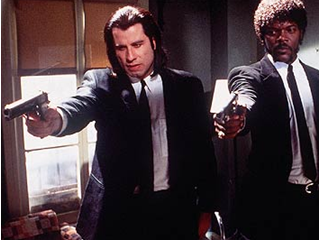
For those who share this embarrassing omission with me and, consequently, aren't familiar with the plot, I'll do my best to try to give a rundown. Pulp Fiction is Quentin Tarantino's Oscar nominated masterpiece from the mid 90s. It weaves several plots together into a beautiful, fast-paced, non-linear, film. Our stars are John Travolta (when he was still making good films) as Vincent Vega, and Samuel L. Jackson as Jules Winnfield: two hitmen who work for Marcellus Wallace (Ving Rhames.) Vincent is tasked with taking Wallace's wife, Mia (Uma Thurman) out for a night on the town. And that's just one subplot. There's a mysterious opener for the movie involving a diner robbery by two lovers (Tim Roth and Amanda Plummer) of which we have to wait two hours to see the outcome. There is also a great subplot involving a boxer named Butch (Bruce Willis.) The subplots are connected through Marcellus and play out back and forth like a tennis match throughout the film.
Movies longer than two hours can be very hit or miss for me. Wonderfully applauded films such as There Will Be Blood or The Lord of the Rings films can lose some of their value when it requires the viewer to set aside a whole afternoon to watch. Pulp Fiction clocks in at 154 minutes, which is hefty. That's not to say that movies cannot be constantly entertaining for more than two hours. When I watched Gangs of New York for the first time, I was itching for more after 166 minutes. But it's a tall order to fill, and Pulp Fiction had me for the full run time. It's constantly got your attention. Tarantino is a master of dialogue, as usual. His films tend to weigh in on the long side, but they're never boring. Of course, the action is all well and good, but even his dialogue is a thrill to sit through.
The prize of the film is its actors in roles of all sizes. Travolta is wonderful and lays down a multifaceted character. He's a hitman you can love. Samuel L. Jackson as Jules Winnfield, on the other hand, is a hitman you must love. Jackson commands every single scene that he's a part of, from his zealous bible quoting to his wonderful sense of humor. The role makes it clear why Samuel is a huge star even today. He's a Tarantino frequent flyer and he's wonderful every time. My brother and I have always agreed that every Kubrick shot is a photograph worthy of framing. In the same way, every Tarantino line is a quote worthy of remembrance, especially Jules'. Jackson's character is incredible and never a bore to watch while Travolta's covers a more subdued range. They're the perfect duo. The film is some of Uma Thurman's best work. Her scenes with Travolta are natural and filled with sexual tension. Horror movies have tremendous suspense, but it's possible to have suspense without anyone getting gored and Thurman and Travolta nail that idea in every one of their scenes.
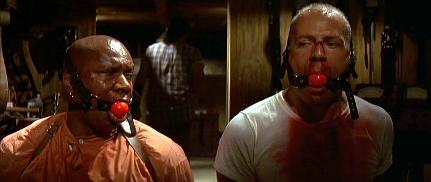
Bruce Willis is known more today for his hollow action films, but there was a time where his roles were deep and troubled. He's certainly a wonderful actor, but he's stopped showing it often. In the 80s and 90s, he took roles that meant something and Butch in this film is no exception. You feel for the guy. He's a bit of a brute, but he's someone you can sympathize with. He puts his life in danger to retrieve a family heirloom. No matter how much he yells in the movie, Willis' performance always has that subtext that he's only lashing out because he wants to hold onto his father. Willis is the unlikely heart of the film. His mercy towards Marcellus is made potent yet believable by Willis. Ving Rhames is a wonderfully intimidating man, perfect for the sort of man that Marcellus Wallace is. The scene after Marcellus' rescue between Willis and Rhames is perfect. The actors take their time, and you can feel the shame and violation from Rhames resulting from the heinous act performed on him. As with most of the characters in this movie, Marcellus is brutal, but you feel for him and accept his brutality.
One of the prominent treasures of Tarantino movies are his bit parts. He writes these incredibly wonderful characters and only puts them in a scene or two and rips them away from us right when we've realized why we love them. He also goes the extra mile in hiring some of the best actors imaginable to play these people. It's a common Tarantino tactic, but it is extra apparent in Pulp Fiction. There's Tim Roth and Amanda Plummer as Pumpkin and Honey Bunny. They appear in only one location, but their intensely good screen chemistry makes them memorable. Tim Roth's scene with Samuel L. Jackson is one of the better parts of the movie for me. There is also the legendary Harvey Keitel as Winston Wolf, a to-the-point "cleaner" reminiscent of Breaking Bad's Mike Ehrmantraut, except with style. One of the most talked about and quoted scenes of the entire movie features a character who only has a few minutes of screen time. It's an incredibly small part and, in reality, Tarantino could have hired just about anyone, but he went with a screen legend: Academy Award winner Christopher Walken as Captain Koons. It's the funniest damn scene in the whole movie. As in many of his films, Tarantino also plays a role as Jules' friend Jimmie.


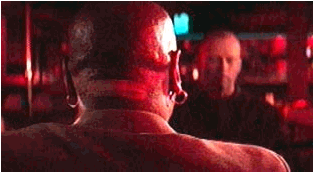
Like all Tarantino films, the movie has style in all aspects. Its shots are beautiful and iconic. Any of the above photos would make welcome additions to my wall space as posters. An especially effective shot is how the whole scene between Marcellus and Butch early on in the film is seen only as a shot of Bruce Willis and the back of Ving Rhames' head. It instantly creates a sense of mystery and danger surround Marcellus, which is important to the rest of the film because the stakes of every character relies on Marcellus being effectively terrifying to cross. Vincent nearly letting Mia die under his watch or Butch trying desperately to avoid Marcellus or Marcellus himself when he is freed from his bondage and put in a room alone with his rapists would not be the same if we weren't scared to death of Marcellus from the very start. Tarantino accomplishes that effect with a single shot in a single scene.
Tarantino's use of music first struck me when I watched the two Kill Bill movies for the first time. Tarantino has no problem letting wonderful music take center stage in his films. It is a marriage of film and music when you see a Tarantino film. Quentin knows how to pick his music. He never makes the music subtle or pushed to the background. Quentin wants us to know that the music is important. It's almost a character in the film. A particularly memorable music scene in this specific film is the use of Chuck Berry's "You Never Can Tell" in the restaurant with Mia and Vincent.

So is this film worth all the insane hype that it gets? Of course. I saw nearly every other Tarantino film before this one and this is a clear front runner. It is endlessly entertaining, beautifully structured, and fantastically written. Tarantino doesn't seem to be capable of a bad film. His movies are filled with style, humor, and entertainment. If not for the experience of the story itself, go see the film for the sake of being able to respond to your friends' exclamations of "What does Marcellus Wallace look like?" with a proud and loud "Does he look like a bitch?"
Rating: 5/5
See it for: The Quotes, The Music, Samuel L. Jackson
Quote of the Movie: "Does he look like a bitch?" -- Jules Winnfield (And pretty much anything else that comes out of Jules' mouth)


No comments:
Post a Comment